A Sea-Doo is easy to enjoy and surprisingly easy to learn, but it doesn't drive like a car or a boat. This guide walks a complete beginner through operating our Sea-Doos safely on New Hampshire lakes — from the keys in your hand to towing a tube behind you. We also cover it all in person at delivery, so think of this as your head start.
Wear your life jacket and clip the kill-switch lanyard to it. Start with the learner key until you're comfortable. Remember you steer with throttle — let off completely and you stop turning.
Stay slow (headway speed) within 150 feet of shore, docks, swimmers, and boats. Avoid shallow water. Ride only in daylight. And always cut the engine completely when anyone is getting on or off in the water.
This tutorial is your plain-language head start, but it doesn't replace the manufacturer's operator's guide for the ski you're renting — those cover starting, controls, safe loading, and care in full detail. We ask every renter to read through the operator's guide for their ski before getting on the water.
📄 Sea-Doo Wake 155 (SK-01) Operator's Guide (PDF)
📄 Sea-Doo GTR 230 (SK-02) Operator's Guide (PDF)
1. Before you launch: lanyard first, learner key second
Two small things make the biggest difference to your safety, and both happen before you ever touch the throttle.
The safety lanyard (kill switch)
Every Sea-Doo has a coiled lanyard that clips between the ignition and your life jacket. Clip it to your life jacket before you start the engine, every single time. If you come off the craft, the lanyard pulls free and the engine shuts down instantly — so the ski doesn't speed away or circle back toward you. It's the single most important habit on the water.
Learner key vs. sport key
Our Sea-Doos come with two keys, and which one you use changes how the craft behaves. The learner key caps the top speed and gentles the acceleration — perfect for your first time out, for newer riders, and for getting a feel for the controls. The sport (regular) key unlocks full power once you're confident.
2. Starting, stopping, and the golden rule around people
Starting is simple: lanyard clipped on, sit down, and press start. To slow down, ease off the throttle and let the craft glide — there's no brake, so you plan your stops a little earlier than you would in a car.
Always switch the engine completely OFF before anyone gets on or off the craft from the water. A spinning jet intake is dangerous to swimmers. When you pull up to collect a rider who's swimming, kill the engine first, then let them climb on from the rear boarding step.
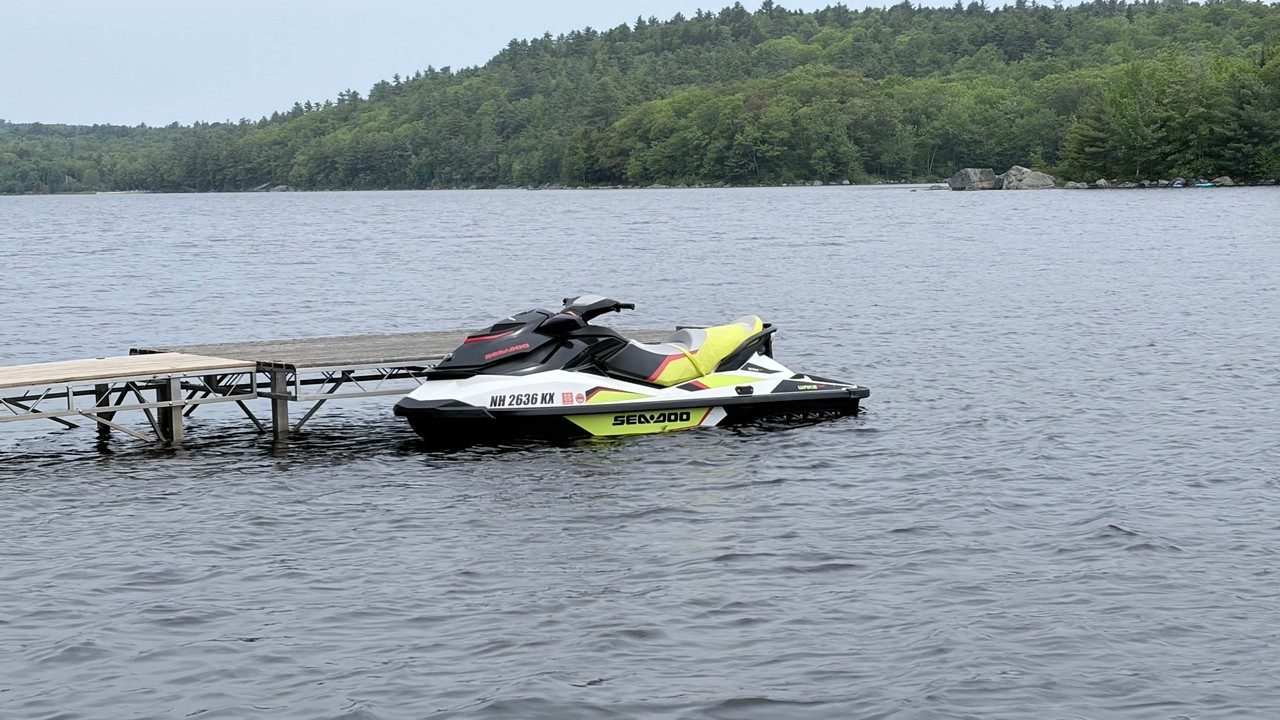
3. The thing that surprises everyone: you steer with throttle
This is the most important difference between a Sea-Doo and anything else you've driven. A jet ski turns by aiming the jet of water it pumps out the back — which means it only steers when you're giving it throttle. Turn the handlebars with no power and very little happens.
For a beginner this has one critical consequence: if an obstacle appears and your instinct is to chop the throttle and turn away, you'll keep going straight. The correct move is to keep gentle, steady power on while you steer around it. You'll practice this in the first five minutes and it'll quickly feel natural.
Don't whip the handlebars and pin the throttle at the same time — a hard turn under heavy acceleration can throw a passenger off the back. Lean gently into turns, keep speed reasonable, and warn your passenger before you change direction.
4. Speed and distance: the 150-foot rule
New Hampshire law sets a clear rule that keeps everyone safe and protects shorelines from wake. You must travel at headway speed — the slowest speed that still lets you steer, roughly 6 mph — whenever you're within 150 feet of the shore, docks, swim rafts, mooring fields, swimmers, or other boats. You can only open up the throttle once you're more than 150 feet clear.
A few lakes carry their own posted speed or distance rules on top of this — we'll flag anything specific to your lake when you book.
5. Daylight only — plan your ride
In New Hampshire, personal watercraft may be operated only between sunrise and sunset. Riding after dark is not allowed, so build your day around getting back to the dock with daylight to spare. Check the forecast before you head out — wind picks up chop on the bigger lakes in the afternoon — and tell someone on shore your rough plan and when to expect you back. If you're heading somewhere far, plot your route first (more on that below).
6. Stay out of shallow water (protect the impeller)
A Sea-Doo doesn't have an exposed propeller — it draws water up through an intake on the bottom and pushes it out through an impeller. That's great for swimmers' safety, but it means the craft is hungry for whatever is on the lake bottom in shallow water. Run it through shallows and it can suck up sand, gravel, weeds, and rocks, which damages or destroys the impeller — an expensive repair and an instant end to your fun.
If you can see the bottom clearly or you're close to a beach, you're too shallow to be on the throttle. Idle slowly out to deeper water before getting up to speed, and approach beaches and put-ins at a crawl.
7. Reading the water: buoys and markers
New Hampshire lakes use the same buoy system as the rest of the country. A quick refresher keeps you in safe, legal water:
- Red and green channel markers mark safe passage. The classic memory aid is "red, right, returning" — keep red markers on your right when returning from open water toward shore or upstream. Green stays on the other side.
- White buoys with an orange band, circle, or diamond are regulatory: they mark no-wake zones, hazards, swimming areas, or restricted areas. Read them and obey them.
- Mooring balls (usually white) mark anchored boats — give them a wide berth and headway speed.
8. Going far? Bring a map and plot your course
The bigger lakes — Winnipesaukee especially — are large, island-dotted, and easy to get turned around on. If you're planning a longer ride, look at a lake map before you go, pick out a few landmarks, and have a rough course in mind. A waterproof lake map or a downloaded map on a phone in a waterproof case is well worth it. Keep an eye on your fuel and your time so the return trip is comfortable and in daylight.
9. Towing a tube, skier, or wakeboarder
Towing is some of the most fun you can have — and it comes with specific New Hampshire rules. Here's what you need to know before you tow anyone:
- You need an observer. NH law requires a spotter at least 13 years old, in addition to the operator, watching the person being towed. (For three or more people on tubes, two observers are required.)
- Everyone towed wears a life jacket — always.
- Daylight only. Towing is illegal between sunset and sunrise, just like riding.
- Keep your distance. The operator and the towed rider together are responsible for staying 150 feet from shore, swimmers, and other boats; release skiers heading away from shore, not toward it.
- Easy on the throttle. Accelerate smoothly to take up slack, and avoid sharp turns that whip the rider — especially important with the extra weight of a passenger and a towed load.
Towing requires advance written approval, and our Sea-Doo Wake 155 is the tow-sport craft. If tubing or wakeboarding is on your list, tell us when you book so we can set you up correctly. See the fleet →
10. Docking, beaching, and mooring your Sea-Doo
When you stop for lunch, take a swim, or tie up at the end of the day, how you secure the Sea-Doo matters just as much as how you ride it. The goal is always the same: keep the hull from grinding against anything hard. A few simple habits protect the craft — and your security deposit.
Mooring is the gentlest option
Whenever you have the choice, mooring the ski in open, deeper water — on a mooring ball or buoy — is the kindest thing you can do for the hull. Floating free, nothing rubs against it. The one thing to avoid is mooring or anchoring where the water is too shallow: a breeze will push the ski back and forth, and in the shallows that means the hull dragging over rocks, dirt, or even firm sand — exactly the kind of contact that scratches and gouges. Give yourself enough depth that the wind can't swing the craft onto the bottom.
Beaching on soft sand
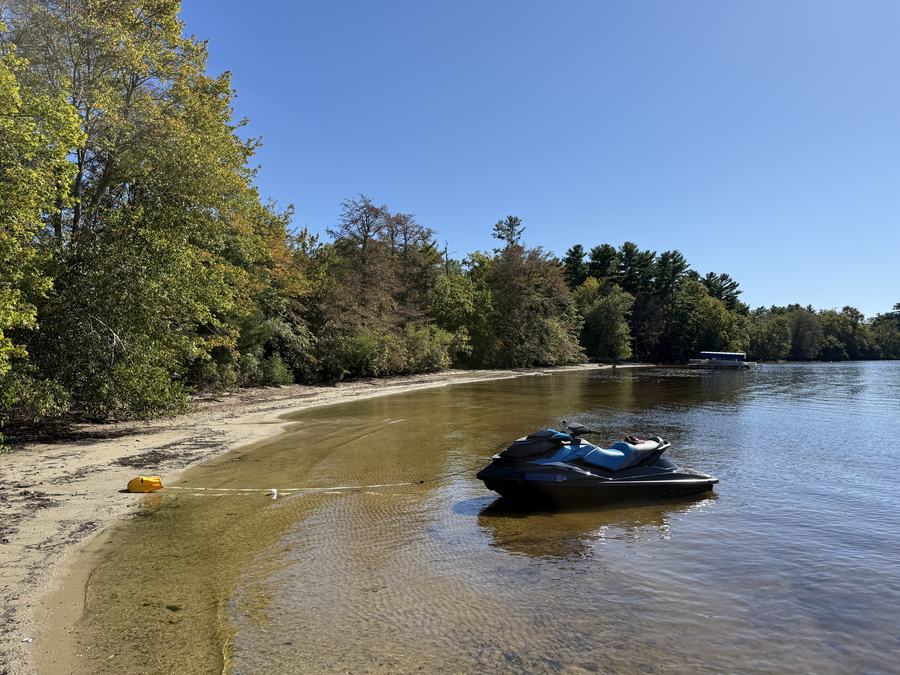
If the shoreline is soft and sandy, with no rocks, you can store the ski right on the beach. Cut the engine while you're still a little way out and let the ski glide slowly in under its own momentum — never power it up onto the sand. As it reaches the beach, lift the bow and ease it the rest of the way until it's resting securely on the sand. Then run a line from the bow to something fixed on land — a tree, a post, or a heavy anchor — so a shift in the wind can't float it back out while you're away. That single bow line is cheap insurance against chasing a drifting ski.
Tying up to a dock
Your rental comes with a pair of soft tow bumpers — use them any time you bring the ski alongside a dock so the hull never touches the wood directly. When you're under way, stow the bumpers in the front trunk so they stay out of the way and don't go overboard.
- Hang the bumpers along the hull on the dock side, positioned as shown below, so they sit between the ski and the dock and take the contact instead of the fiberglass.
- Tie off with the supplied bungee cords so the ski is held snug against the dock but can still rise and fall with the water.
- If the dock has posts or pilings that stick out, it's usually better to put the bumpers on the posts themselves rather than on the ski. That way the hull stays protected even if the ski shifts a foot or two along the dock — the cushioning is right on the hard edge where it's needed.
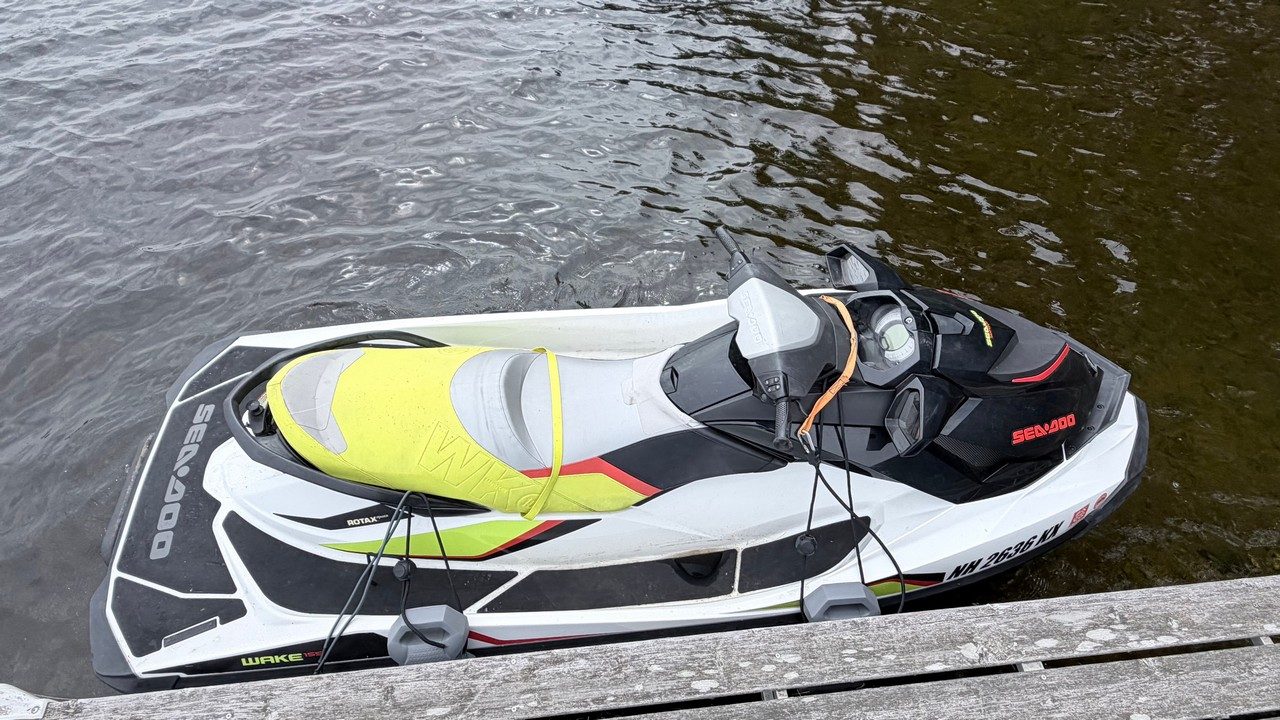
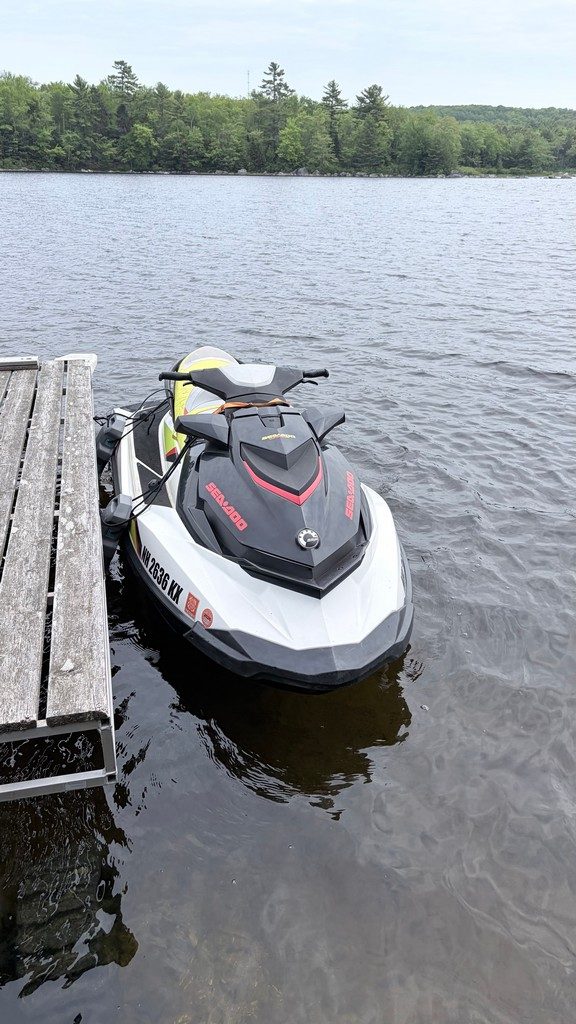
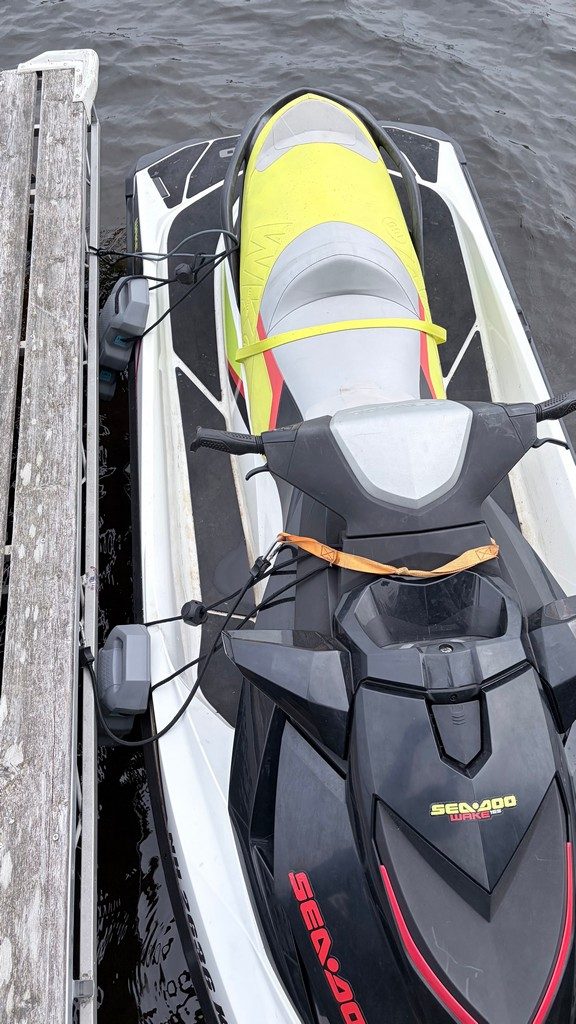
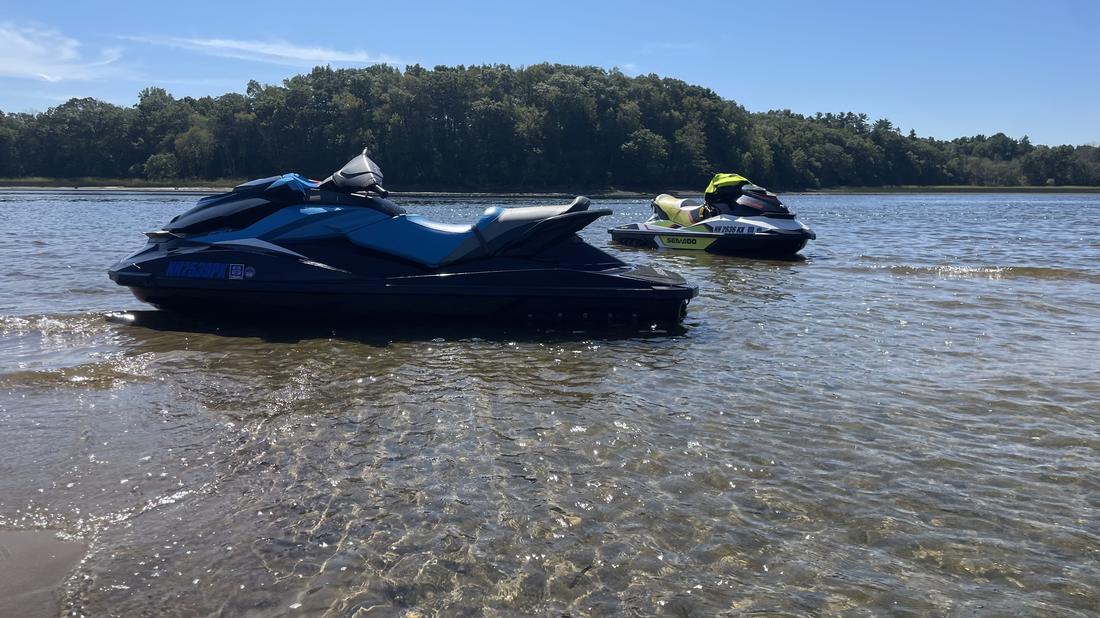
However you stop, don't leave the ski sitting in shallow water where wind can work it back and forth over rocks, dirt, or sand — that's how hulls get scratched and gouged. Either beach it fully on soft sand, tie it to a dock with the bumpers, or moor it where there's room to float.
11. Your quick pre-ride checklist
- ☑️ Operator's guide for your ski read beforehand (linked at the top of this page)
- ☑️ Life jacket on every person aboard
- ☑️ Kill-switch lanyard clipped to your life jacket
- ☑️ Learner key in for new riders
- ☑️ Fuel checked and a rough route in mind
- ☑️ Weather and daylight checked — back before sunset
- ☑️ Boating certificate and ID with you
- ☑️ Engine OFF before anyone boards from the water
Ready for your first ride?
We cover all of this in person at delivery — then the lake is yours for the week.
Check Availability & Book